OpenCDA-MARL
Cooperative multi-agent reinforcement learning for autonomous driving, built on OpenCDA: the same signal-free intersection scenarios run on CARLA (full vehicle stack) or on SUMO (traffic only, orders of magnitude faster), and any learner that implements one small contract trains inside the framework's episode loop with checkpoints, metrics and the experiment matrix included.
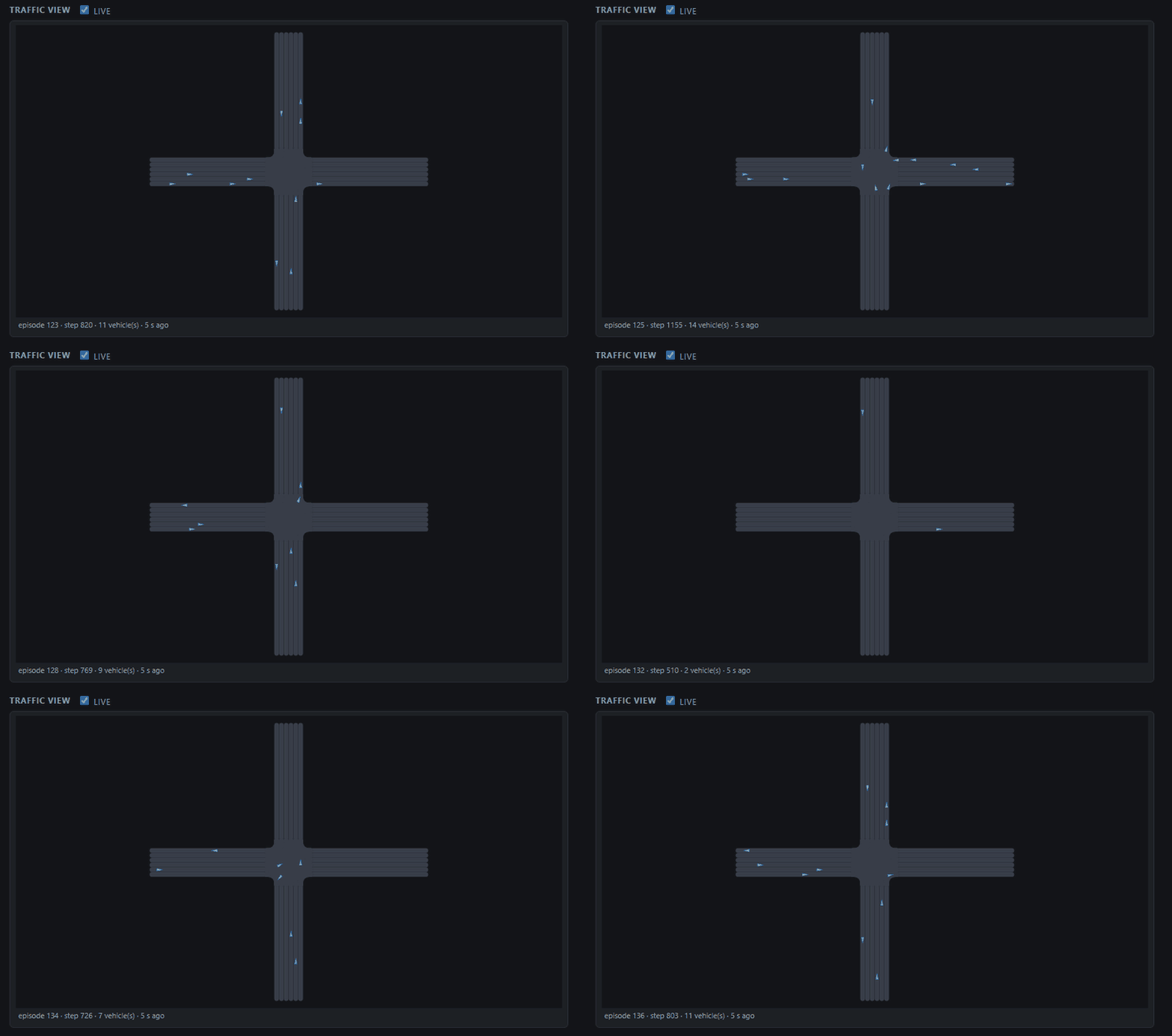
The web monitor's traffic view: a signal-free intersection during a live SUMO run, learning agents in blue — headless, no CARLA rendering.
Four pages
-
Run a bundled learner untouched — SUMO, headless, monitor included — then change one thing.
-
One sealed lifecycle, many replaceable joints: the map of every plugin kind, port and config seam an experiment can swap or vary.
-
One run, the monitor, the experiment matrix: the launcher with parallel runs on a multi-GPU box, resume, evaluation and analysis.
-
Plug in a learner (Add an Algorithm), swap a lifecycle joint (Replace a Component), or drive the scenarios from your own RL stack through the PettingZoo port.
Install first: Installation and
CARLA Version Support. Developing the
framework itself — as a person or a coding agent — starts at
AGENTS.md
(Contributing is the short form).
What ships
- Learners: MAPPO, MASAC, MATD3, DQN and tabular Q-learning; PCMAPPO and PCMASAC build on PCMA (without its preference planner) for multi-objective training, and PCMATD3 is preference-conditioned only — all registered through the same interface an external package uses.
- Baselines: the framework paper's DQN, MAPPO and SAC checkpoints and
most of its TD3 ones (all but the two 1024-wide TD3-44d runs, which
retrain from the
td3_44dprofile) ship in the wheel with their profiles and the deterministic recordings they were trained against — a fixed reference point for comparison. - Backends: CARLA 0.9.15 / 0.9.16 (0.10.0 experimental), SUMO via libsumo, CARLA–SUMO co-simulation.
- Infrastructure: one verified lifecycle across backends with CARLA world reloads that carry the full learner state; resumable runs; a SQLite metrics store with a live web monitor and schematic traffic view; the experiment matrix launcher with per-slot CARLA servers and GPU spreading.
Citation
If you use OpenCDA-MARL, please cite the framework paper (and OpenCDA); the BibTeX is in the repository README. The preference-conditioned learners build on arXiv:2606.14693 (without its preference planner) — cite it with them (PCMA Learners).
Acknowledgments
- Developed at the Radar Lab, University of Arizona (About).
- Built on OpenCDA by the UCLA Mobility Lab, CARLA, SUMO and Pixi.
- The OpenCDA-MARL code is licensed under the Apache License 2.0; the vendored OpenCDA core keeps UCLA's academic, non-commercial licence, and other third-party material keeps its own terms — see THIRD_PARTY_NOTICES.md.