XCalib
Camera-LiDAR cross-modal matching for edge devices: pretrained matchers, targetless extrinsic calibration, ONNX/TensorRT export, HDF5 training, and label-free one-shot adaptation — behind one small API.
xcalib is the deployment package for the matching front-end studied in Position Encoding in
Detection-Based LiDAR–Camera Matching: A Diagnostic Study at Infrastructure Sites (accepted at
IEEE Sensors Letters; final publisher URL pending). It runs the same weights on a lab
workstation and an NVIDIA Jetson AGX Thor, and builds on the lab's prior calibration framework
CalibRefine (Cheng et al., IEEE
TIM 2026, arXiv:2502.17648).
Status — publicly released and actively developed. The public API (
xcalib.__all__) is stable across minor versions; internals may change without notice. Broader visibility is expected once the accompanying IEEE Sensors Letters paper is published. New versions are cut frommainas tagged releases.
Install
pip install XCalib            # inference
pip install "XCalib[onnx]"    # + ONNX export / onnxruntime parity checks
pip install "XCalib[train]"   # + h5py for HDF5 training
For normal use, install the PyPI wheel once it is published; a source checkout is only needed for development, paper validation, or local experiments.
Requires Python 3.10+ (CI tests 3.10 through 3.14). The wheel pins torch>=2.2 only — on Jetson
keep the JetPack/PyPI torch you already have.
Quickstart
After installing the wheel, import Matcher, load a released checkpoint, and
pass one camera/LiDAR frame with detector boxes:
import numpy as np
from xcalib import Matcher

# First call downloads and caches the released checkpoint/config.
matcher = Matcher.from_pretrained("crlite", site="a9_dataset_r02_s01")

image = np.zeros((720, 1280, 3), dtype=np.uint8)  # H,W,3 RGB
points = np.random.default_rng(0).uniform(
    low=[-20.0, -20.0, -2.0],
    high=[50.0, 20.0, 4.0],
    size=(4096, 3),
).astype(np.float32)
boxes_2d = np.array([[420.0, 260.0, 520.0, 360.0]], dtype=np.float32)
boxes_3d = np.array([[8.0, -1.5, -1.0, 11.5, 1.5, 1.6]], dtype=np.float32)

result = matcher.match(
    image=image,
    point_cloud=points,
    bboxes_2d=boxes_2d,       # K,4 (x1,y1,x2,y2) in pixels
    bboxes_3d=boxes_3d,       # M,6 (xmin,ymin,zmin,xmax,ymax,zmax) in meters
    top_k=1,
)

print(result.similarity.shape)  # (K, M)
print(result.matches)           # [(img_idx, lid_idx, score), ...]
For real frames, replace the arrays above with decoded RGB images, LiDAR points, and boxes from your detector. See Input protocol for the exact shape/dtype contract.
Everything a deployment needs hangs off the Matcher:
| call | does |
|---|---|
Matcher.from_pretrained(model, site=...) |
load packaged config + released/local weights |
.match(...) / .pair(...) |
K x M similarity, top-k matches, latency |
.calibrate(frames, intrinsics=K) |
targetless PnP/RANSAC extrinsics |
.oneshot(K) |
one-shot adaptation session (pseudo-labels, adapter) |
.train(train_h5, val_h5) |
fine-tune the loaded weights on HDF5 caches |
.build("onnx" \| "trt") |
export whatever weights are loaded |
.save_pretrained(dir) |
persist weights + config locally |
Training and dataset helpers:
from xcalib import train, load_dataset

best = train("crlite", "a9_dataset_r02_s01", "a9_dataset_r02_s01",
             site="a9_dataset_r02_s01", epochs=100)
loader = load_dataset("a9_dataset_r02_s01", split="test")
External Configs
Packaged YAMLs under xcalib/cfg/ are just defaults. For custom weights or
site-specific experiments, pass any external YAML path (or a plain dict /
EdgeConfig) through the same config= argument:
matcher = Matcher.from_pretrained(
    "crlite",
    weights="runs/site42/best.pth",
    config="runs/site42/crlite_site42.yaml",
)
The config is loaded before the model is built, so it can change architecture knobs such as
embed_dim, token_len, top_k, crop_size, point_cloud_size, vit.depth, vit.num_heads,
gnn.num_layers, gnn.hidden_dim, similarity_head.hidden_dims, and CalibRefine dense.*
widths/dropouts. If a cfg changes tensor shapes, the checkpoint must have been trained with that
same cfg; released A9/UTC checkpoints should use their packaged YAMLs.
See it in action
Both clips are rendered from the public A9 (TUMTraf intersection) test cache with real checkpoints —
regenerate them any time with pixi run python scripts/make_demo_media.py.
For single-frame diagnostics in your own notebooks or reports, use the package
helpers in Visualization.
Matching — matcher.match()
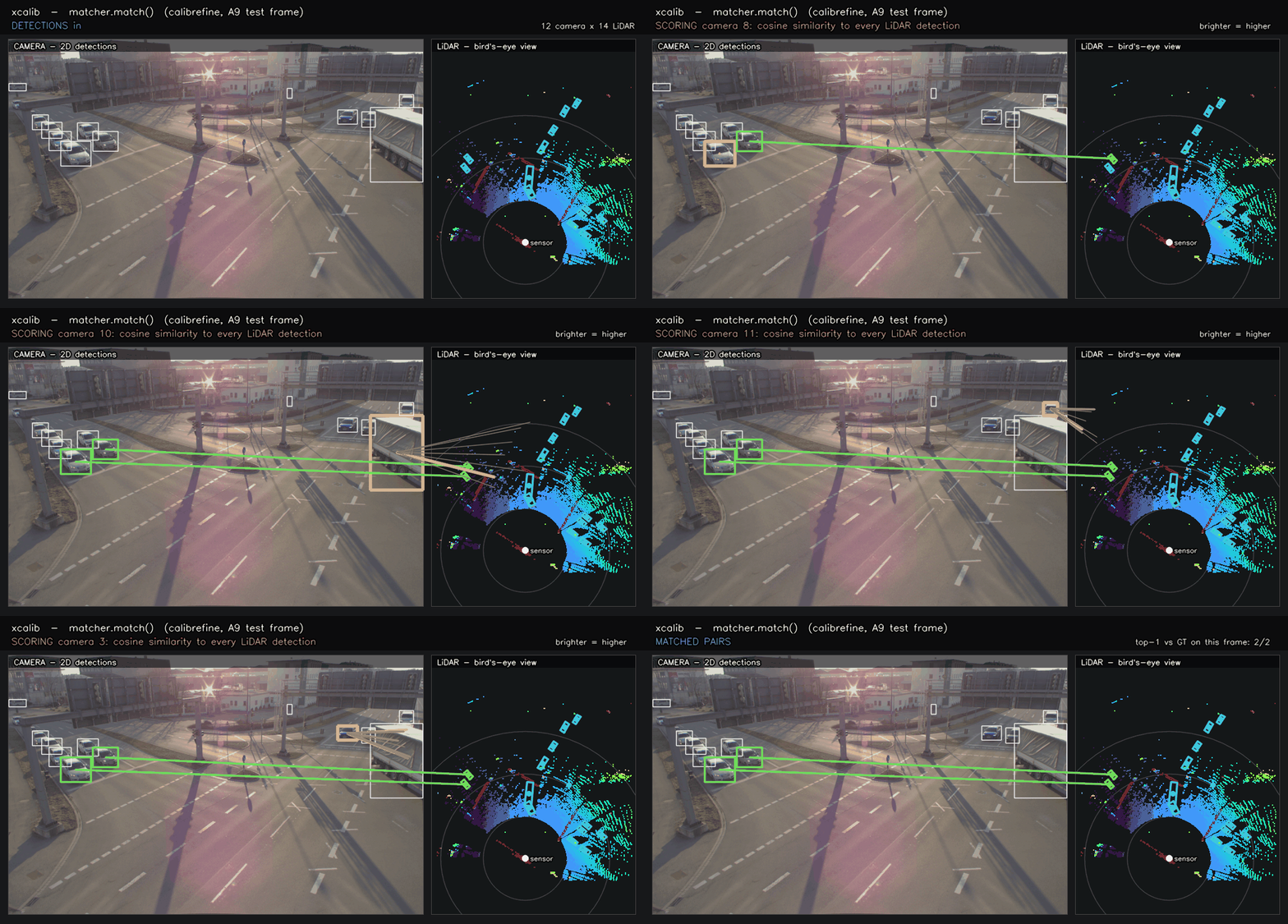
One frame, two unregistered sensors. The matcher embeds every camera detection (left, 2D boxes) and every LiDAR detection (right, bird's-eye view of the native cloud with 3D footprints), scores all camera x LiDAR pairs by cosine similarity, and takes the argmax per camera detection. Confident rows lock as green camera-to-LiDAR links; rows whose best score stays below the threshold are left unmatched on purpose — at an intersection the two sensors never see exactly the same set of objects.
Calibration — matcher.calibrate()
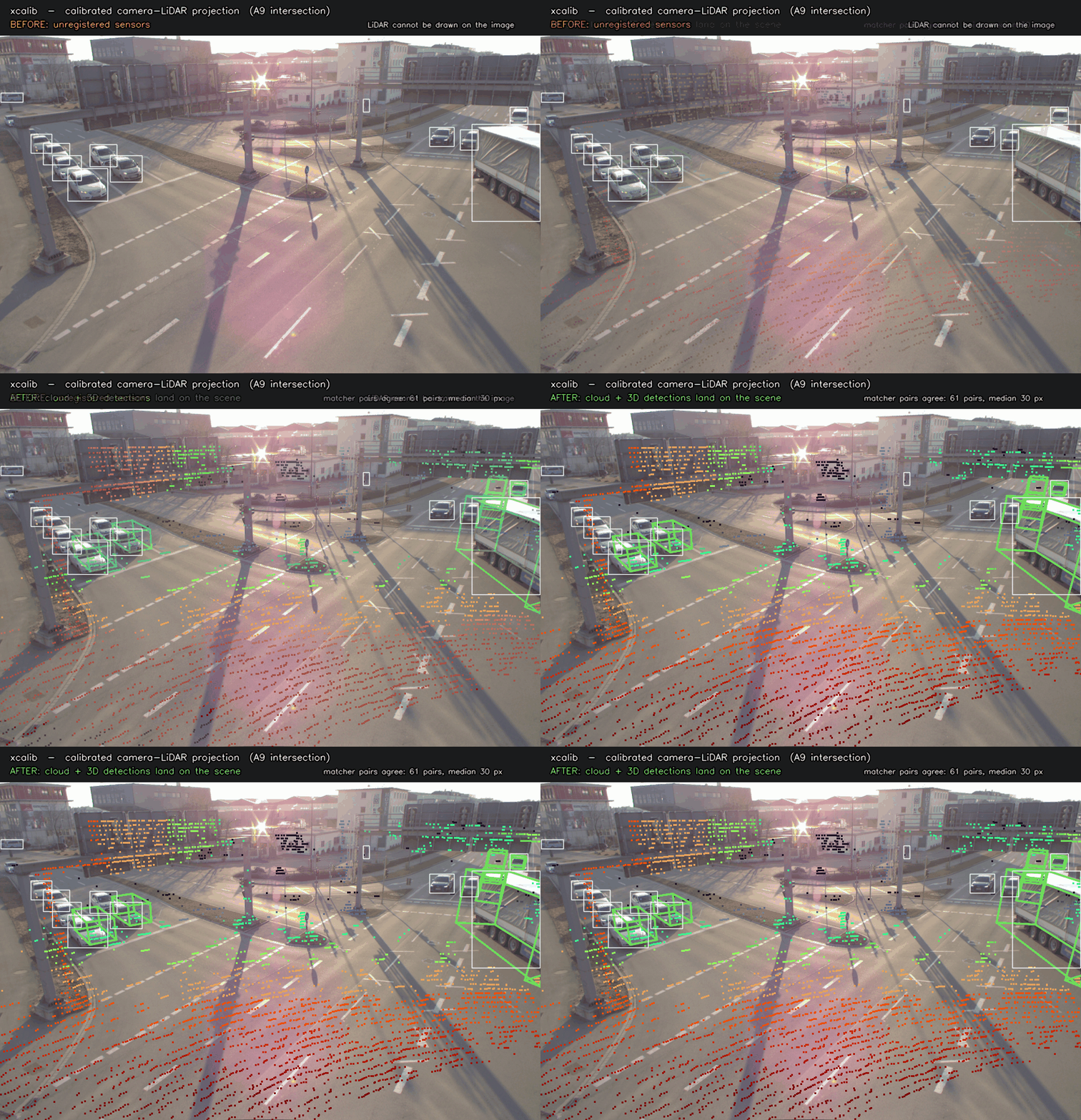
Calibration is what those matches buy you. CalibrationSession accumulates confident (2D box
center, 3D box center) pairs across frames and solves PnP/RANSAC with the camera intrinsics the
protocol requires — recovering the extrinsics with no checkerboard or survey target. The overlay
shows the calibrated projection at this intersection: LiDAR scan lines land on the road surface and
the 3D detections wrap the vehicles. The matcher's 61 confident pairs from this 29-frame clip agree
with the projection shown to a ~30 px median, which is the camera-box-center vs LiDAR-centroid
offset, not noise.
(Full disclosure: this public test slice is a flat intersection, so the matched vehicle centers are
nearly coplanar and a 6-DoF PnP solution is under-constrained — the figure therefore projects
through the intersection's
published reference calibration.
calibrate() recovers the pose itself when the buffered matches span varied depth and height —
longer clips, mixed vehicle sizes, non-flat scenes.)
One-shot adaptation — matcher.oneshot()
Once a projection matrix exists, it becomes a free supervisor. An OneShotSession watches
deployment frames, keeps only the matches that are both confident and geometrically consistent
with the projection (the matched LiDAR center must land near its camera box), and uses those
pseudo-labels to train small identity-initialized adapters on top of the frozen backbone — no human
labels, and the paper-grade weights are never overwritten. session.save() /
matcher.save_pretrained() persist the site-adapted weights when you are happy with them.
Model zoo
| Model | Backbone | Position encoding | Tier |
|---|---|---|---|
crlite |
ResNet + PointNet | Enhanced 3D (2D-sin + depth + 3D MLP) | paper |
crlite_2dpe |
ResNet + PointNet | 2D-only | paper |
crlite_vit_exp1 |
crop-ViT + PointNet | none | paper |
crlite_vit_exp3 |
crop-ViT + PointNet | Enhanced 3D | paper |
calibrefine |
ResNet + PointNet2 | 2D sinusoidal (pairwise) | paper baseline |
crlite_vit_exp4 |
crop-ViT + PointNet + GAT | edge-aware GAT | delivery only |
calibrefine is our standalone port of the Common Feature Discriminator from
CalibRefine (Cheng et al., IEEE
TIM 2026, arXiv:2502.17648), kept as the pairwise baseline the
paper compares against.
Released paper checkpoints and the public A9 cache can be loaded from the Hub or from local files; see Models and datasets.
Where next
- Input protocol — the exact contract
match()enforces. - Visualization — draw matching links and calibrated LiDAR projections.
- Models and datasets — load released weights and A9 dataset caches.
- Custom checkpoints and models — load external weights/configs, or add a new packaged architecture.
- HDF5 cache format — what
train()/load_dataset()read. - API reference — the curated public API.
- Reproducing the paper — validation commands and reference numbers.
- Paper evidence — frozen JSON evidence and public/private data scope.
API stability
Only the symbols exported by xcalib.__all__ (and documented in the API reference) are
stable across minor versions. Anything imported from submodules (xcalib.engine.*,
xcalib.models.*, ...) is internal and may change without notice.
Citation
The xcalib paper has been accepted at IEEE Sensors Letters. This entry keeps a temporary paper URL note until the publisher page is live:
@article{guo2026xcalib,
  author  = {Guo, Lihao and Tang, Jiahao and Bang, Tam and Zhang, Tianya and
             Harris, Austin and Sartipi, Mina and Cao, Siyang},
  title   = {Position Encoding in Detection-Based LiDAR--Camera Matching:
             A Diagnostic Study at Infrastructure Sites},
  journal = {IEEE Sensors Letters},
  year    = {2026},
  note    = {Accepted. Paper URL pending. Code:
             https://github.com/radar-lab/XCalib},
}
For the calibrefine baseline / prior framework:
@article{cheng2026calibrefine,
  author  = {Cheng, Lei and Guo, Lihao and Zhang, Tianya and Bang, Tam and
             Harris, Austin and Hajij, Mustafa and Sartipi, Mina and
             Cao, Siyang},
  title   = {CalibRefine: Deep Learning-Based Online Automatic Targetless
             LiDAR-Camera Calibration With Iterative and Attention-Driven
             Post-Refinement},
  journal = {IEEE Transactions on Instrumentation and Measurement},
  volume  = {75},
  year    = {2026},
  note    = {arXiv:2502.17648. Code:
             https://github.com/radar-lab/Lidar_Camera_Automatic_Calibration},
}